Postingan

Menampilkan postingan dengan label Technology

Pembuatan Media Pembelajaran Daring Kreatif
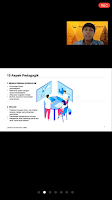
Gambar
Catatan ini saya dapatkan sewaktu menjadi peserta dalam acara webinar yang diselenggarakan oleh Universitas BINUS pada tanggal 10 Oktober 2020. Pembicara dalam webinar ini adalah Suwarno, S. Si., M. Pd.  Foto 1. Pembicara menyampaikan materi Online learning adalah pembelajaran yang dilakukan melalui jaringan internet. Istilah tersebut memiliki beberapa sinonim, seperti e-learning, internet learning, web-based learning, tele-learning, distributed learning (Ally, 2008). Pembelajaran daring memiliki 3 poin, yakni interaksi pembelajar - konten, pembelajar - instruktur, dan pembelajar - pembelajar.  10 Apek pedagogik: sesuai dengan kurikulum, inklusi, keterlibatan pembelajar, pembelajaran efektif, penilaian formatif, peniaian sumatif, koherensi, konsistensi dan transparansi, kemudahan penggunaan dan efektifitas biaya. Jenis pembelajarand daring ada 2, yaitu synchronous learning (semua online pada waktu bersamaan) dan asynchornous learning (menggunakan media komunikasi tidak langsun...

The Online Educator: Innovation and Accessibility (Week 2)

The second week of MOOC online educator discussed the myth about online education is more accessible than face-to-face education. It appeared two terms, inclusion and accessibility. Inclusion in the educational context means that remove the barriers for equalities while accessibility means equal participation for people with disability. So, it is true for some people that online education is more inclusive because it offers the opportunity for all people no matter what they race are, their background is, or their area is. But at some points, online education can be costly as well because of internet bills and website maintenance.  There was a survey about student barriers to online learning developed by Muilenburg and Berge, 2005 and it mentioned 8 barriers to online learning. Those were administrative/instructor issues, social interactions, academic skills, technical skills, learner motivation, time and support for studies, cost and access to the internet, and technical p...

The Online Educator: People and Pedagogy by Open University (Week 1)

This time, I am joining MOOC The Online Educator: People and Pedagogy which is offered by Open University and this MOOC course can be found in the FutureLearn website. This MOOC is divided into four weeks. It is about disruption and design, innovation and accessibility, evidence and ethics, and the last is about the importance of online identity for educators. In this occasion, I will write my summary of what I learn in the first week. The first week is clustered into three categories and those are the myth, hype, and reality in online education, put people first, and from people to pedagogy.  As we know that there are some changes in education and there is also the evolution in higher education all over the world. There are more opportunities for students to learn, such as gamification, social and international experiences. Institutions also must be attentive to faculty autonomy and students agency, to ensure that data and technology complement human judgment and personal exper...

Deep-Play: Developing TPACK for 21st Century Teachers (A Summary)

This is a summary of a paper that I read. The title of the paper is Deep-Play: Developing TPACK for 21st Century Teachers which was written by Matthew J. Koehler, Punya Mishra, Emily C. Bouck, Michael DeSchryver, Kristen Kereluik, Tae Seob Shin, and Leigh Graves Wolf. The paper has been published in International Journal Learning Technology Vol. 6 No. 2 in 2011.  Introduction Teachers face some difficulties in integrating technology into their classroom because of new technologies, like Smart Boards, YouTube, Google Earth, iPads, Flickr, and GPS devices, bombard teachers from all directions. In this paper, they explored specialized kinds of knowledge that teachers need to re-design technology, approaches that use the knowledge to foster the teachers' skills to create, design and play with technology and ideas. They also introduced learning technology by design (LT/D) as an approach to fostering TPACK knowledge and to re-design the educational technology in the classroom. The...

Stalled Innovation: Examining the technological, pedagogical and content knowledge of Australian university educators (A Summary)

The paper entitled Stalled Innovation: Examining the technological, pedagogical and content knowledge of Australian university educators was written by Karin Barac, Sarah Prestridge, and Katherine Main who had an affiliation with Griffith University, Australia. The paper was published in Australian Educational Computing in 2017 Vol 32(1). Introduction Some people argued that there is still little evidence to support claims for widespread renewal of this magnitude in the daily business of higher education (Oliver, 2012; Price&Kirkwood, 2014; Russell, Malfroy, Gosper&McKenzie, 2014; Selwyn, 2014). These studies suggest that the introduction of technologies alone will do little to transform education if it is not linked to pedagogies. The purpose of the study was to explore the nexus between pedagogy and technology in higher education, especially how technology is being used in specific relationship to the content and whether pedagogy is being shaped by the technology. The p...

Developing a TPCK-SRL assessment scheme for conceptually advancing technology in education: A Summary

The paper entitled developing a TPCK-SRL assessment scheme for conceptually advancing technology in education was written by Zehavit Cohen and Bracha Kramarski from Bar-Ilan University, Israel. Th paper was submitted for Elsevier Journal studies in educational evaluation in 2012. The paper was about TPCK and Self-Regulated Learning (SRL)of 9 preservice teachers in Israel. In that paper, the writers followed the new TPCK-SRL approach that emerged from the transformative approach and shares its view of TPCK as a body of knowledge that goes beyond the integration of constituent bases toward their transformation into something new. The SRL refers to the cyclical stage process what the so-called comprising forethought, action and performance, and reflection (Zimmerman, 2000). In that process, learners asked themselves what, how, when, and why questions.  Researchers also indicated that although TPCK has significant implications for the education of the teachers and t...

iTELL 2018: Day 2

Hi guys... This time I am going to write my experience in joining second iTELL conference 2018 on the second day. There were presenters on the second day, similar to the first day but there were two plenary speakers on the second day and those are from UNS and British Council.  The first plenary speaker was Ms. Drajati and she is a lecturer at UNS. She presented about TPACK in the concept and practice in the classroom. Maybe some of you are new to this term, so am I. So, TPACK stands for Technological Pedagogical and Content Knowledge. Her presentation is quite interesting and since this is a millennial era whereas many youths are using technologies in their life.  As we know that the number of people who use mobile keeps increasing from time to time. It was about 0.08 percent of the population that connected to the internet in 2003, then it increased to 1.84 in 2010, 3.47 percent in 2015 and it is predicted that there will be about 6.58 percent people in the world conn...